Understanding Curly Hair Types: The Complete Guide to Every Curl Pattern

Curly hair is beautiful, versatile, and full of personality — but not all curls are the same. From soft beachy waves to tight coily textures, every curl type has unique characteristics, needs, and styling methods. Understanding your curl pattern can help you choose the right products, haircuts, and routines to keep your hair healthy and defined.
Here’s a complete guide to the different types of curly hair and how to care for each one.
What Are Curl Types?
Curl types are generally divided into four major categories:
Type 1 — Straight Hair
Type 2 — Wavy Hair
Type 3 — Curly Hair
Type 4 — Coily/Kinky Hair
Curly hair mainly falls into Types 2, 3, and 4. Each category is further divided into A, B, and C subtypes based on how loose or tight the curls are.
Type 2: Wavy Hair
Type 2 hair has gentle bends and waves rather than full curls. It tends to be flatter near the roots and becomes more defined toward the ends.
Type 2A — Soft Waves
Characteristics
Loose “S” shaped pattern
Fine to medium texture
Easy to straighten
Lightweight with slight volume
Best Care Tips
Use lightweight shampoos and conditioners
Avoid heavy creams and oils
Use sea salt sprays for texture
Type 2B — Defined Waves
Characteristics
More visible wave pattern
Slight frizz at the crown
Medium texture
Better volume than 2A
Best Care Tips
Use curl-enhancing mousse
Diffuse while drying for definition
Apply anti-frizz serums
Type 2C — Thick Waves
Characteristics
Strong wave pattern
Thick and voluminous
Some loose spiral curls
Prone to frizz
Best Care Tips
Use sulfate-free shampoos
Deep condition weekly
Apply lightweight curl creams

Type 3: Curly Hair
Type 3 hair forms visible curls and spirals. These curls are naturally bouncy and full of volume.
Type 3A — Loose Curls
Characteristics
Large, loose spirals
Shiny and soft texture
More prone to losing definition
Best Care Tips
Use lightweight curl creams
Avoid brushing dry curls
Scrunch hair while styling
Type 3B — Springy Curls
Characteristics
Well-defined ringlets
Medium density
More shrinkage than 3A
Frizz-prone
Best Care Tips
Use leave-in conditioners
Apply gels for curl definition
Sleep with a satin bonnet or pillowcase
Type 3C — Tight Corkscrew Curls
Characteristics
Tight corkscrew curls
Very voluminous
Dense texture
Can become dry quickly
Best Care Tips
Moisture is essential
Use rich curl butters and creams
Minimize heat styling

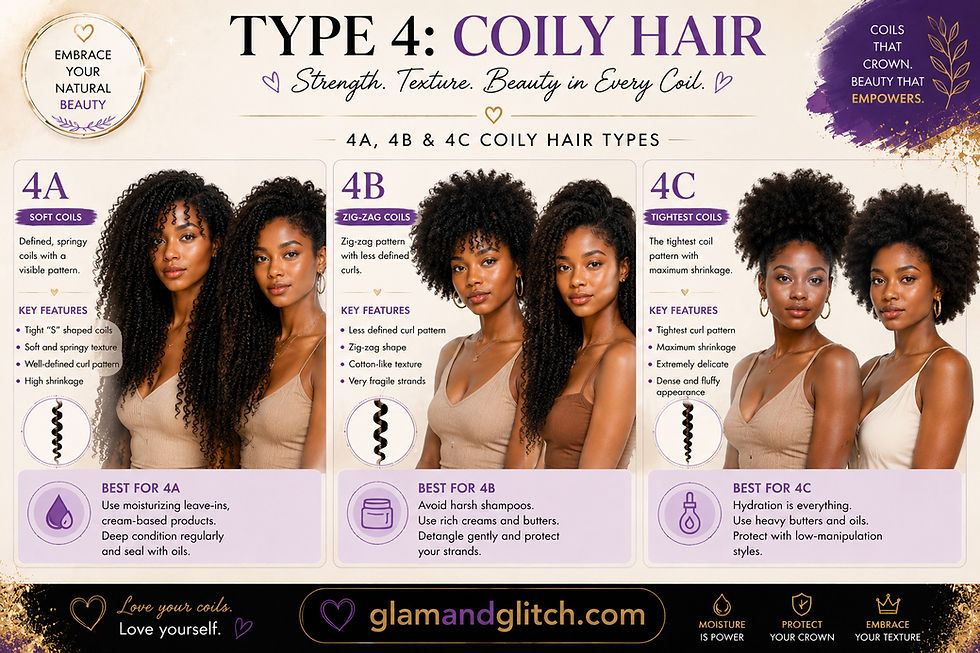
Type 4: Coily Hair
Type 4 hair has tight coils or zig-zag patterns and is the most delicate curl type due to natural dryness.
Type 4A — Soft Coils
Characteristics
Tight “S” shaped coils
Soft and dense texture
High shrinkage
Best Care Tips
Use moisturizing leave-ins
Deep condition frequently
Seal moisture with oils
Type 4B — Zig-Zag Coils
Characteristics
Less defined curl pattern
Cotton-like texture
Very fragile strands
Best Care Tips
Avoid harsh shampoos
Use protective styles
Detangle gently with conditioner
Type 4C — Tightest Coils
Characteristics
Tightest curl pattern
Maximum shrinkage
Extremely delicate
Often appears dense and fluffy
Best Care Tips
Focus heavily on hydration
Use rich butters and oils
Protective styling helps reduce breakage
How to Identify Your Curl Type
Here are some simple ways to determine your curl pattern:
1. Wash and Air Dry Your Hair
Avoid styling products and let your natural texture appear.
2. Observe the Curl Shape
Loose “S” pattern = Type 2
Spiral curls = Type 3
Tight coils or zig-zag pattern = Type 4
3. Check Hair Thickness
Fine, medium, or coarse strands affect how products work on your hair.
4. Consider Porosity
Hair porosity determines how well your hair absorbs moisture.

Final Thoughts
Every curl pattern is unique and beautiful. Understanding your hair type is the first step toward building the perfect curly hair routine. Whether you have soft waves, defined ringlets, or tight coils, the key to healthy curls is moisture, gentle care, and using products designed for your specific texture.

Embrace your natural curls, experiment with routines, and remember — healthy curls always look the best.


Comments